

Map Snapshot


8 Records
Status
Relationships
Citations
No citations linked for this taxon yet.
Source: Wikipedia
| Hypomyces luteovirens | |
|---|---|
Scientific classification 
| |
| Kingdom: | Fungi |
| Division: | Ascomycota |
| Class: | Sordariomycetes |
| Order: | Hypocreales |
| Family: | Hypocreaceae |
| Genus: | Hypomyces |
| Species: | H. luteovirens
|
| Binomial name | |
| Hypomyces luteovirens | |
| Hypomyces luteovirens | |
|---|---|
| Mycological characteristics | |
 | Smooth hymenium |
 | Lacks a stipe |
 | Ecology is parasitic |
 | Edibility is not recommended |
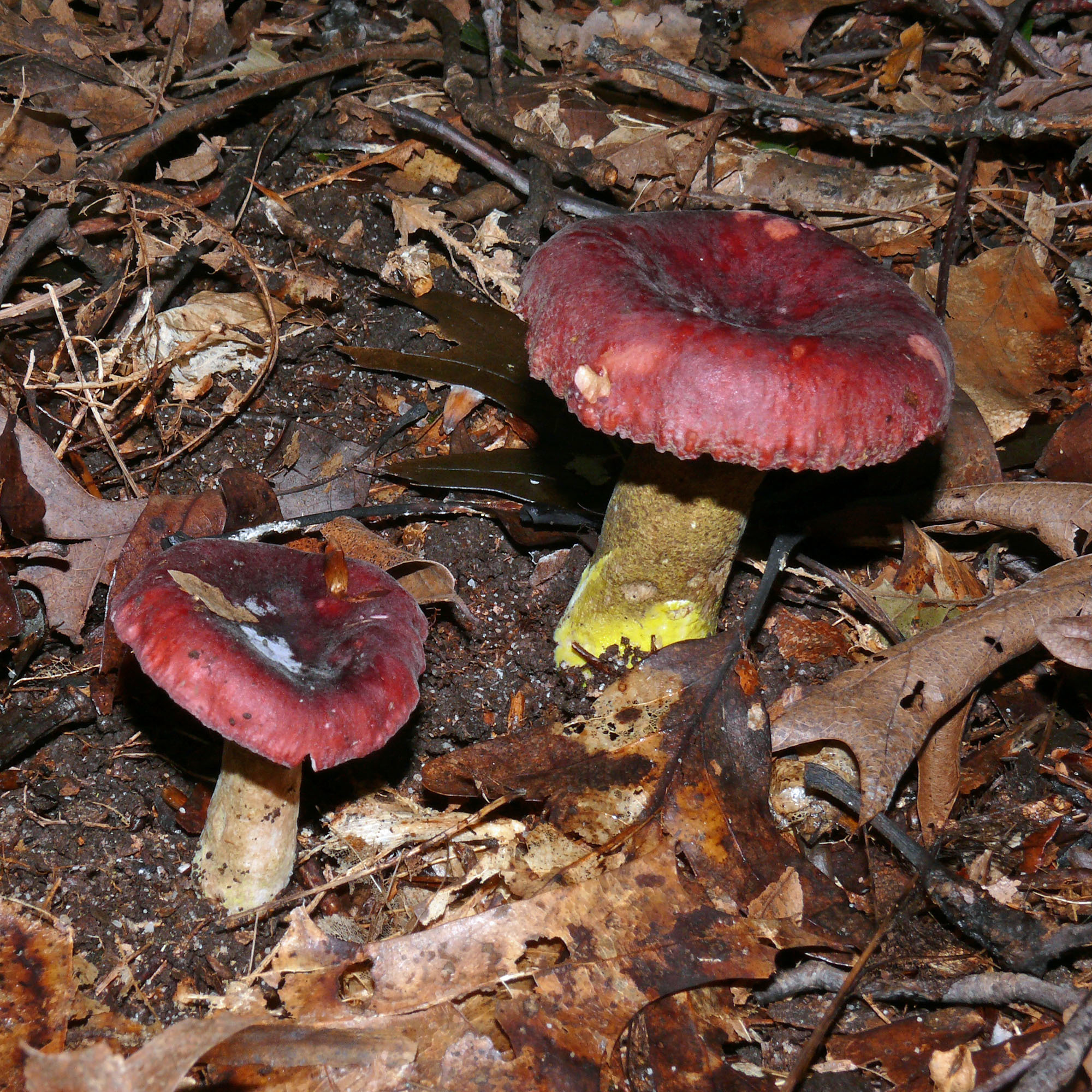
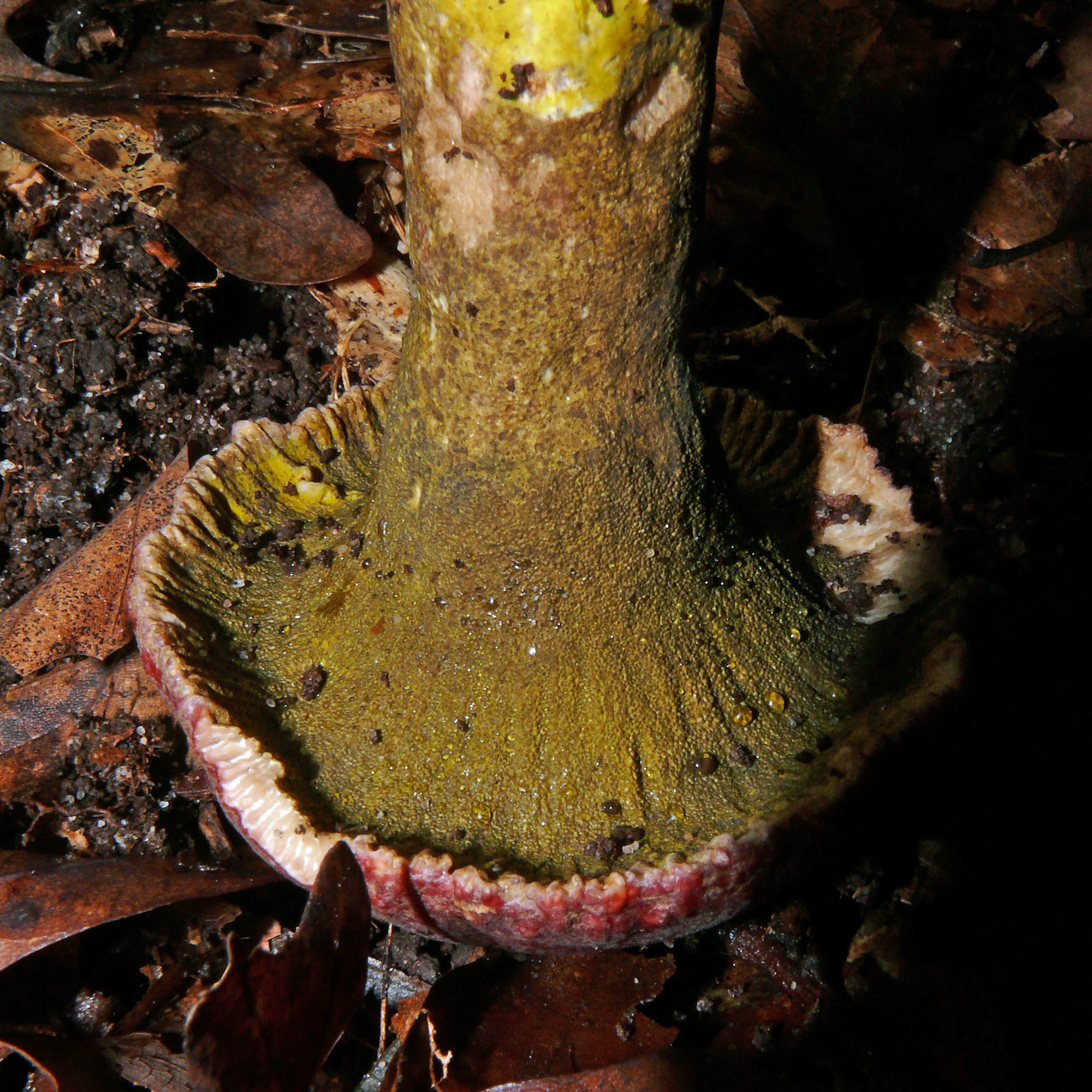
Hypomyces luteovirens, commonly known as the green langoustine,[1] is a parasitic fungus in the genus Hypomyces. It is a green mold that grows on certain Russula mushrooms. It sometimes grows on Lactarius species. It is not recommended for consumption, because its host species and host edibility are largely unknown.[1]
Description
[edit]The fruiting body of Hypomyces luteovirens is a crusty,[2] bumpy[3] moldlike structure that grows on certain Russula[2] and Lactarius[4] mushrooms. It starts out white[5] or yellow, becoming light green and eventually dark green as it matures.[3] The fungus rarely covers the cap of its host[3] and typically only covers the gills and upper stipe.[6][2] The fungus makes its host's gills look more shallow,[1] destroying their structure. H. luteovirens produces tiny[2] parathecia in order to release its spores.[5]
Habitat and ecology
[edit]Hypomyces luteovirens is a parasite to Russula mushrooms, especially purple and red ones.[2] It also sometimes grows on Lactarius mushrooms.[4]
References
[edit]- ^ a b c Siegel, Noah; Schwarz, Christian (September 1, 2024). Mushrooms of Cascadia: A Comprehensive Guide to Fungi of the Pacific Northwest. Humboldt County, CA: Backcountry Press. p. 247. ISBN 9781941624197.
- ^ a b c d e "Hypomyces luteovirens (MushroomExpert.Com)". mushroomexpert.com. Retrieved 2025-12-09.
- ^ a b c Beug, Michael; Bessette, Alan E.; Bessette, Arleen R. (March 2014). Ascomycete Fungi of North America: A Mushroom Reference Guide. Austin, TX: University of Texas Press. p. 324. ISBN 9780292754522.
- ^ a b Trudell, Steve (October 25, 2022) [January 1, 2009]. Mushrooms of the Pacific Northwest. Timber Press Field Guides (Revised ed.). Portland, OR: Timber Press. p. 367. ISBN 978-0-88192-935-5.
- ^ a b Woehrel, Mary L.; Light, William J. Haugen (2017). Mushrooms of the Georgia Piedmont and Southern Appalachians. Athens, GA: University of Georgia Press. p. 162. ISBN 9780820350035.
- ^ Arora, David. Mushrooms Demystified: A Comprehensive Guide to the Fleshy Fungi (2nd ed.). Berkeley, CA: Ten Speed Press. pp. 92–93. ISBN 9780898151695.