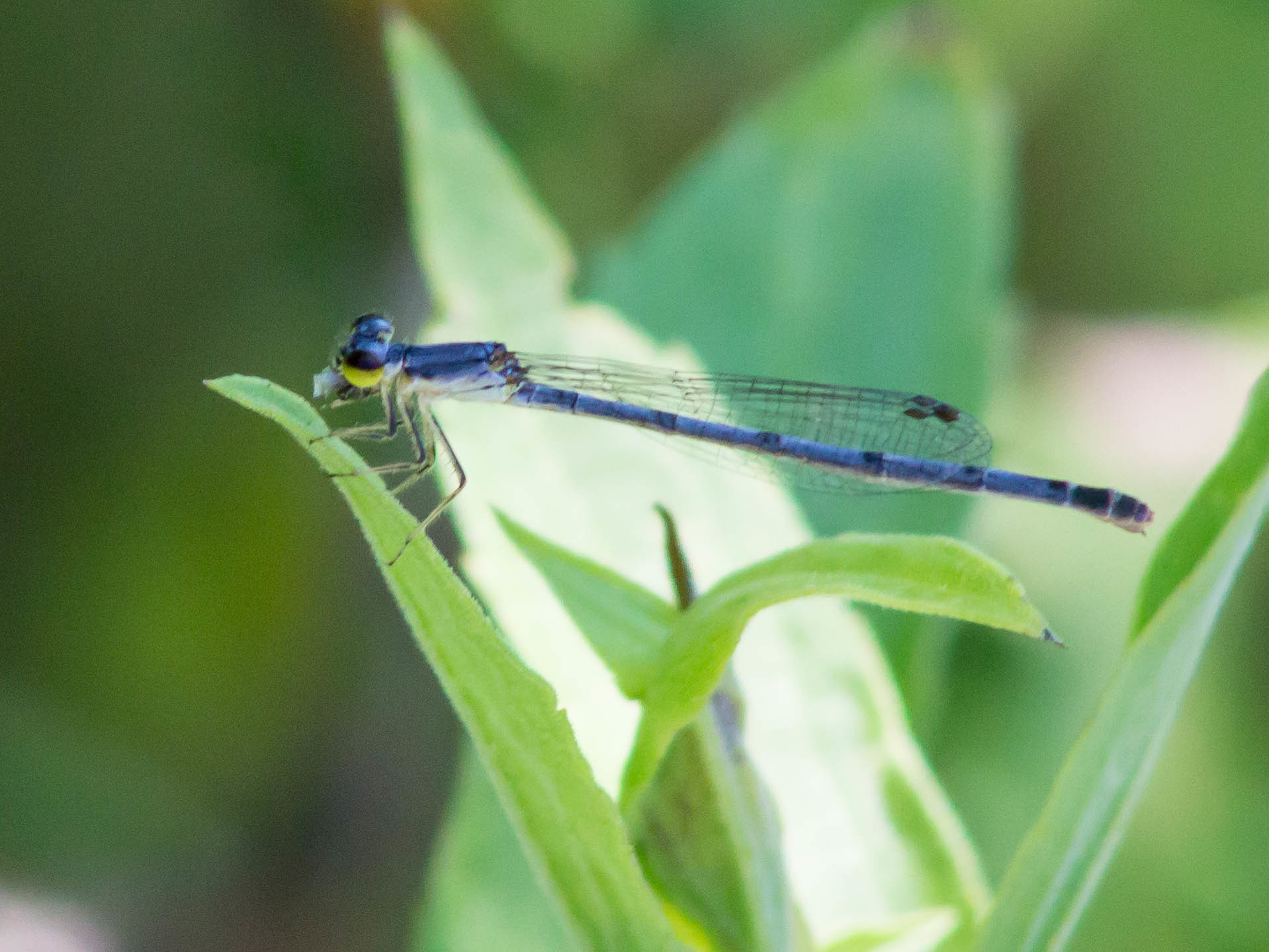
Map Snapshot


71 Records
Citations
No citations linked for this taxon yet.
Source: Wikipedia
| Ischnura | |
|---|---|

| |
| Ischnura heterosticta | |
Scientific classification 
| |
| Kingdom: | Animalia |
| Phylum: | Arthropoda |
| Clade: | Pancrustacea |
| Class: | Insecta |
| Order: | Odonata |
| Suborder: | Zygoptera |
| Family: | Coenagrionidae |
| Genus: | Ischnura Charpentier, 1840[1] |
| Synonyms[2] | |
| |
Ischnura is a genus of damselflies known as forktails or bluetails in the family Coenagrionidae.[2] The genus is distributed worldwide, including various oceanic islands. The males have a forked projection and blue segments at the tip of the abdomen which give the group their common names.[3]
Characteristics
[edit]Forktails are small or very small damselflies. The compound eyes of mature individuals have a dark upper region and contrasting lower part. The thorax is often green and may have lateral stripes and the abdomen in males is black with a blue tip. Females of some species are polymorphic, some being orangish and darkening with age, while others resemble the male.[3]
Etymology
[edit]The genus name Ischnura is derived from the Greek ἰσχνός (ischnos, "thin" or "slender") and οὐρά (oura, "tail"), referring to the slender abdomen of species in the genus.[1][4]
Species
[edit]
The genus Ischnura includes the following species:[5][6]
- Ischnura abyssinica Martin, 1908
- Ischnura acuticauda Lieftinck, 1959
- Ischnura albistigma Fraser, 1927
- Ischnura aralensis Haritonov, 1979
- Ischnura ariel Lieftinck, 1949
- Ischnura asiatica (Brauer, 1865) – Redtail[7]
- Ischnura aurora Brauer, 1865 – Aurora bluetail[7]
- Ischnura barberi Currie, 1903 – Desert forktail[8]
- Ischnura buxtoni Fraser, 1927
- Ischnura capreolus (Hagen, 1861)
- Ischnura cardinalis Kimmins, 1929
- Ischnura cervula Selys, 1876 – Pacific forktail[8]
- Ischnura chingaza Realpe, 2010
- Ischnura chromostigma Fraser, 1927
- Ischnura cruzi De Marmels, 1987
- Ischnura cyane Realpe, 2010
- Ischnura damula Calvert, 1902 – Plains forktail[9]
- Ischnura demorsa (Hagen, 1861) – Mexican forktail[9]
- Ischnura denticollis (Burmeister, 1839) – Black-fronted forktail[8][10]
- Ischnura dorothea Fraser, 1924
- Ischnura elegans (Vander Linden, 1823) – Blue-tailed damselfly[11]
- Ischnura erratica Calvert, 1895 – Swift forktail[8]
- Ischnura evansi Morton, 1919 – Desert Bluetail[12]
- Ischnura ezoin (Asahina, 1952)
- Ischnura filosa Schmidt, 1951
- Ischnura fluviatilis Selys, 1876
- Ischnura forcipata Morton, 1907
- Ischnura fountaineae Morton, 1905 – Oasis bluetail[13]
- Ischnura gemina (Kennedy, 1917) – San Francisco forktail[8]
- Ischnura genei (Rambur, 1842) – Island bluetail[13]
- Ischnura graellsii (Rambur, 1842) – Iberian bluetail[13]
- Ischnura haemastigma Fraser, 1927
- Ischnura hastata (Say, 1839) – Citrine forktail[8]
- Ischnura heterosticta (Burmeister, 1839) – Common bluetail[7]
- Ischnura inarmata Calvert, 1898
- Ischnura indivisa (Ris, 1918)
- Ischnura intermedia Dumont 1974
- Ischnura isoetes Lieftinck, 1949
- Ischnura karafutonis Matsumura, 1931[citation needed]
- Ischnura kellicotti Williamson, 1898 – Lilypad forktail[14]
- Ischnura luta Polhemus, Asquith & Miller, 2000
- Ischnura ordosi Bartenev, 1912
- Ischnura pamelae Vick & Davies, 1988
- Ischnura perparva Selys, 1876 – Western forktail[8][14]
- Ischnura posita (Hagen, 1861) – Fragile forktail[10][14]
- Ischnura prognata (Hagen, 1861) – Furtive forktail[14]
- Ischnura pruinescens (Tillyard, 1906) – Colourful bluetail[7]
- Ischnura pumilio (Charpentier, 1825) – Small bluetail or scarce blue-tailed damselfly[11]
- Ischnura ramburii (Selys, 1850) – Rambur's forktail[8]
- Ischnura rhodosoma Lieftinck, 1959
- Ischnura rubella Navás, 1934
- Ischnura rubilio Selys, 1876
- Ischnura rufostigma Selys, 1876
- Ischnura rufovittata (Blanchard, 1843)
- Ischnura saharensis Aguesse, 1958 – Sahara bluetail[15]
- Ischnura sanguinostigma Fraser, 1953
- Ischnura senegalensis (Rambur, 1842) – Marsh bluetail[16]
- Ischnura spinicauda Brauer, 1865
- Ischnura stueberi Lieftinck, 1932
- Ischnura taitensis Selys, 1876
- Ischnura thelmae Lieftinck, 1966
- Ischnura ultima Ris, 1908
- †Ischnura velteni Bechly, 2000 [17]
- Ischnura verticalis (Say, 1839) – Eastern forktail[10][14]
- Ischnura vinsoni Fraser, 1949
References
[edit]- ^ a b Charpentier, T. (1840). Libellulinae Europaeae Descriptae et Depictae (in Latin). Leipzig: Leopold Voss. pp. 180 [20]. hdl:2027/nyp.33433011575317.
- ^ a b "Genus Ischnura Charpentier, 1840". Australian Faunal Directory. Australian Biological Resources Study. 2012. Retrieved 23 April 2026.
- ^ a b Paulson, Dennis (2009). Dragonflies and Damselflies of the West. Princeton University Press. p. 107. ISBN 978-1-4008-3294-1.
- ^ Endersby, Ian; Fliedner, Heinrich (2015). The Naming of Australia's Dragonflies. Eltham, Victoria, Australia: Busybird Publishing. ISBN 9781925260625.
- ^ Paulson, D.; Schorr, M.; Abbott, J.; Bota-Sierra, C.; Deliry, C.; Dijkstra, K.-D.; Lozano, F. "World Odonata List". OdonataCentral. University of Alabama.
- ^ "Odonata species list". Swedish Museum of Natural History. Archived from the original on 17 January 2011. Retrieved 11 August 2010.
- ^ a b c d Günther Theischinger; John Hawking (2006). The complete field guide to dragonflies of Australia. CSIRO Publishing. ISBN 0-643-09073-8.
- ^ a b c d e f g h "California Damselflies". Dragonflies (Odonata) of the Southwest. Archived from the original on 2009-09-23.
- ^ a b "Species List: Damselflies". azdragonfly.net. Archived from the original on 2011-07-21. Retrieved 2010-08-13.
- ^ a b c Abbott, John (2008). Dragonflies and Damselflies (Odonata) of Texas, Vol 3. Odonata Survey of Texas. ISBN 978-0-615-19494-3.
- ^ a b "Checklist of UK Species". British Dragonfly Society. Archived from the original on 18 September 2012. Retrieved 5 August 2010.
- ^ Boudot, J. P.; van Grunsven, Roy (2021). "Atlas of the dragonflies and damselflies of West and Central Asia". Brachytron. 22: 3–248. doi:10.15468/gt3j2u.
- ^ a b c "Checklist, English common names". DragonflyPix.com. Retrieved 5 August 2010.
{{cite web}}: CS1 maint: deprecated archival service (link) - ^ a b c d e "North American Odonata". University of Puget Sound. 2009. Retrieved 5 August 2010.
- ^ Samraoui, B. & Dijkstra, K.-D.B. (2010). "Ischnura saharensis". IUCN Red List of Threatened Species. 2010 e.T165477A6031236. doi:10.2305/IUCN.UK.2010-3.RLTS.T165477A6031236.en. Retrieved 24 December 2017.
- ^ Sharma, G.; Clausnitzer, V. (2016). "Ischnura senegalensis". IUCN Red List of Threatened Species. 2016 e.T59897A75436136. doi:10.2305/IUCN.UK.2016-3.RLTS.T59897A75436136.en. Retrieved 15 November 2021.
- ^ Toussaint, E. F. A.; Bybee, S. M.; Erickson, R. J.; Condamine, F. L. (8 February 2019). "Forest giants on different evolutionary branches: Ecomorphological convergence in helicopter damselflies". Evolution. 73 (5): 1045–1054. doi:10.1111/evo.13695. PMID 30734925. S2CID 73426853.


| National | |
|---|---|
| Other | |
