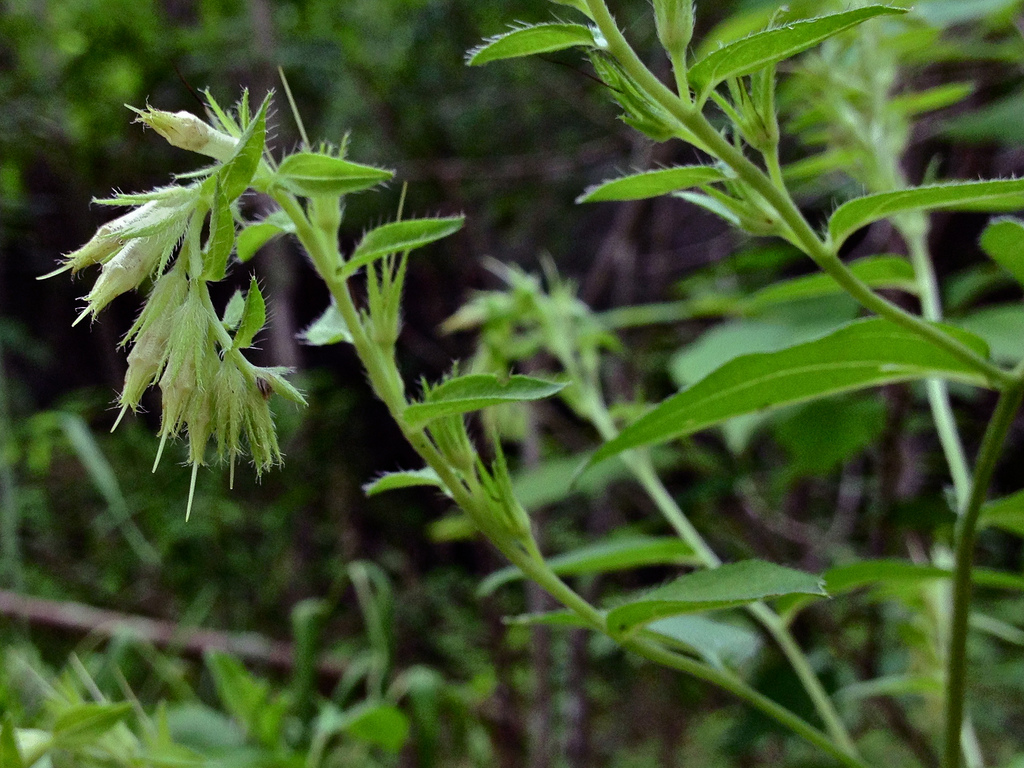
Virginia Marbleseed in Fairfax Co., Virginia (6/11/2013).
Photo by
Fritz Flohr Reynolds
MBP List
Map Snapshot


4 Records
Status
Virginia Marbleseed (also known as Virginia False Gromwell and Wild Job's Tears) is a perennial herb that had a known original range of much of the eastern United States, but it is now endangered in Connecticut, Maryland, New Jersey, and New York; extirpated in Pennsylvania; and historical in Rhode Island, according to the United States Department of Agriculture (2020). Brown and Brown (1984) considered this species infrequent in the Maryland Piedmont and Coastal Plain. It may now be only a historical plant in Maryland (Barrows, et al., 2013). Virginia Marbleseed's habitat is dry sandy woods, open sands, and pinelands (Fernald, 1950).
Relationships
A study by Barrows, et al. (2013) over two growing seasons at Great Falls Park and Chub Sandhill Natural Area, both in Virginia, yielded data "consistent with the hypothesis that L. virginianum requires animal pollination for maximum seed set." The insects they observed visiting the flowers included bumble bees, wasps, butterflies, and moths, and the specific flower visitors differed among the plant's locations.
Citations
No citations linked for this taxon yet.
Use of media featured on Maryland
Biodiversity Project is only permitted with express permission of the
photographer.
Virginia Marbleseed in Fairfax Co., Virginia (6/11/2013).
Media by
Fritz Flohr Reynolds.
Source: Wikipedia
| Onosmodium virginianum | |
|---|---|

| |
Scientific classification 
| |
| Kingdom: | Plantae |
| Clade: | Tracheophytes |
| Clade: | Angiosperms |
| Clade: | Eudicots |
| Clade: | Asterids |
| Order: | Boraginales |
| Family: | Boraginaceae |
| Genus: | Onosmodium |
| Species: | O. virginianum
|
| Binomial name | |
| Onosmodium virginianum (L.) A.DC.
| |
| Synonyms | |
|
Lithospermum virginianum | |

Onosmodium virginianum, common names gravel-weed, wild Job's tears, false gromwell, and Virginia false-gromwell is perennial plant native to the eastern United States.[1]
Distribution and habitat
[edit]O. virginianum's range stretches from Louisiana to Florida, and northwards to New York and Massachusetts.[2]
This species has been observed in environments with dry, loamy soil, such as that found in sandhill and longleaf pine communities.[3]
Conservation status
[edit]It is endangered in Connecticut,[4] Maryland, New Jersey, New York (state), extirpated in Pennsylvania, and as historical in Rhode Island.[5]
References
[edit]- ^ "Plants Profile for Onosmodium virginianum (wild Job's tears)". plants.usda.gov. Retrieved 1 June 2018.
- ^ Weakley, A.S. 2020. Flora of the Southeastern United States. Edition of 20 October 2020. University of North Carolina at Chapel Hill, Chapel Hill, North Carolina.
- ^ Florida State University Robert K. Godfrey Herbarium database. URL: http://herbarium.bio.fsu.edu. Last accessed: June 2014. Collectors: M. Davis, Robert K. Godfrey, R. Komarek, Rodie White, R. A. Norris, and Loran C. Anderson. States and Counties: Florida: Jackson, Leon, and Wakulla. Georgia: Grady and Thomas.
- ^ "Connecticut's Endangered, Threatened and Special Concern Species 2015". State of Connecticut Department of Energy and Environmental Protection Bureau of Natural Resources. Retrieved 31 December 2017.(Note: This list is newer than the one used by plants.usda.gov and is more up-to-date.)
- ^ "Plants Profile for Onosmodium virginianum (wild Job's tears)". plants.usda.gov. Retrieved 1 June 2018.
.jpg) | This Boraginoideae article is a stub. You can help Wikipedia by adding missing information. |