
Map Snapshot


53 Records
Citations
No citations linked for this taxon yet.
Source: Wikipedia
| Desmodium ciliare | |
|---|---|

| |
Scientific classification 
| |
| Kingdom: | Plantae |
| Clade: | Tracheophytes |
| Clade: | Angiosperms |
| Clade: | Eudicots |
| Clade: | Rosids |
| Order: | Fabales |
| Family: | Fabaceae |
| Subfamily: | Faboideae |
| Genus: | Desmodium |
| Species: | D. ciliare
|
| Binomial name | |
| Desmodium ciliare | |
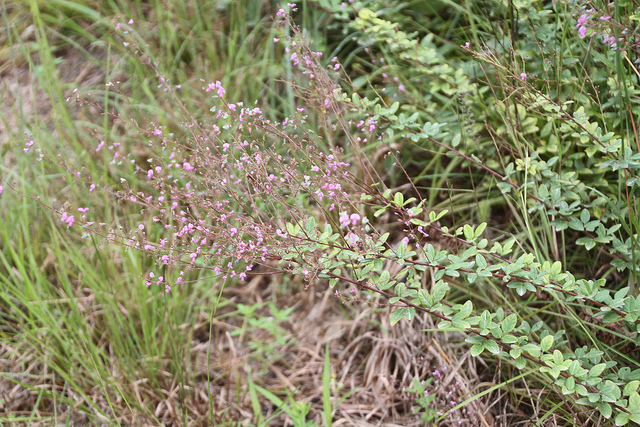
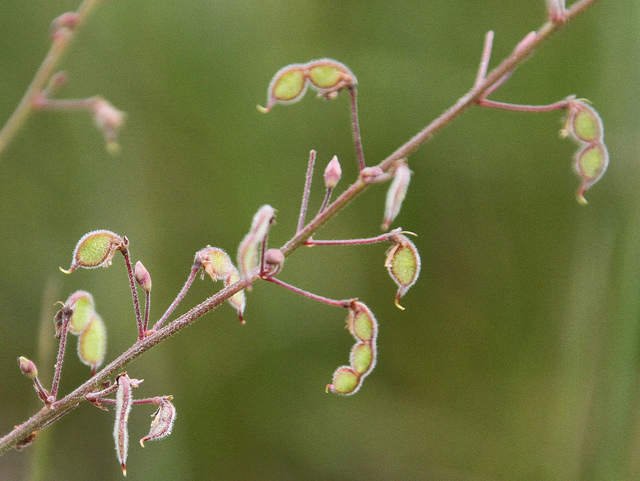
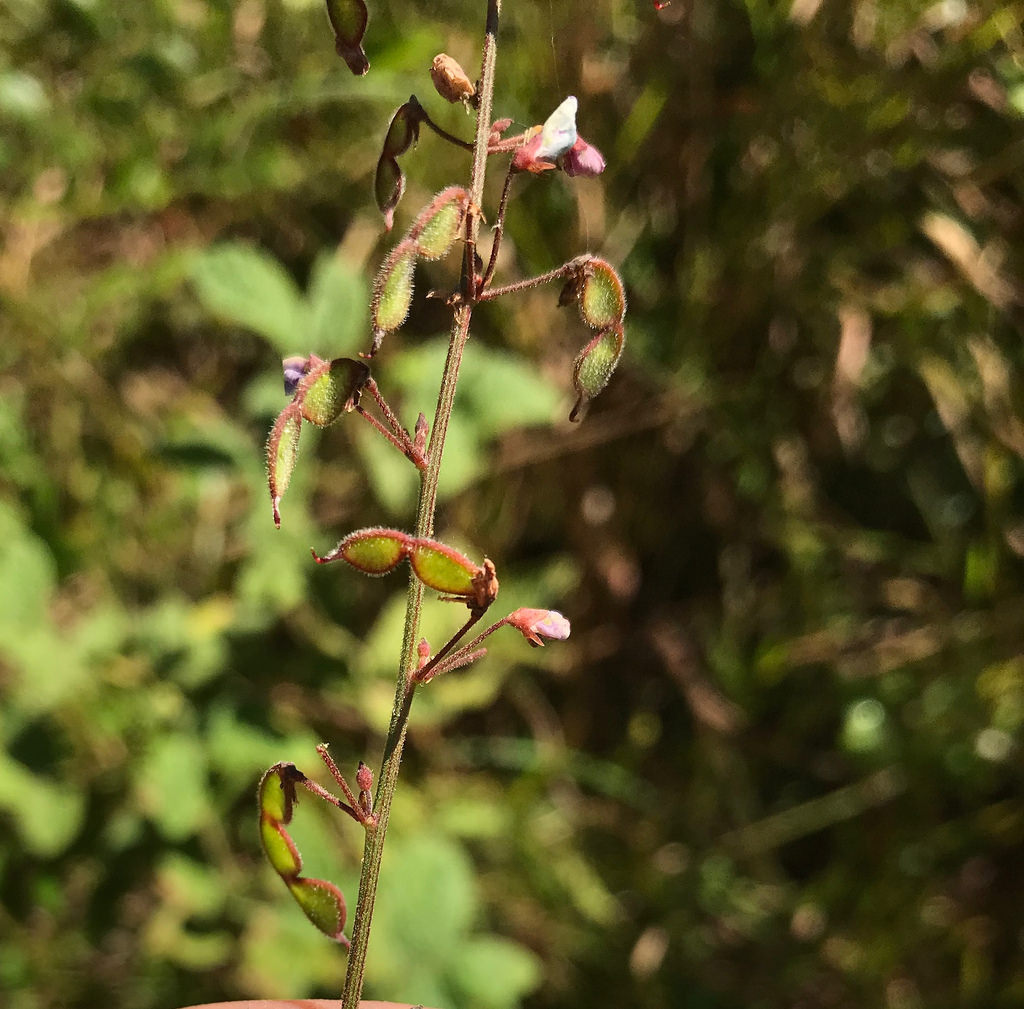
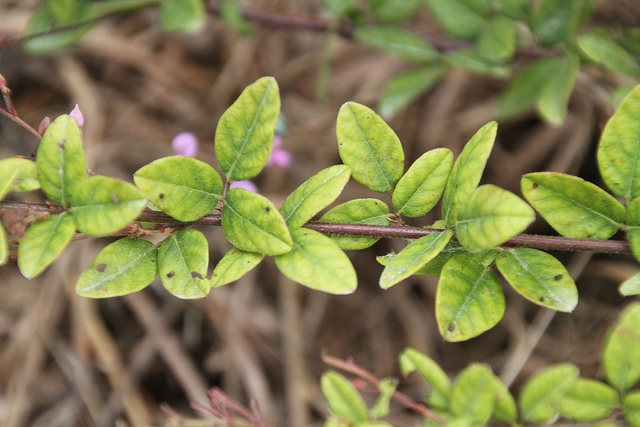
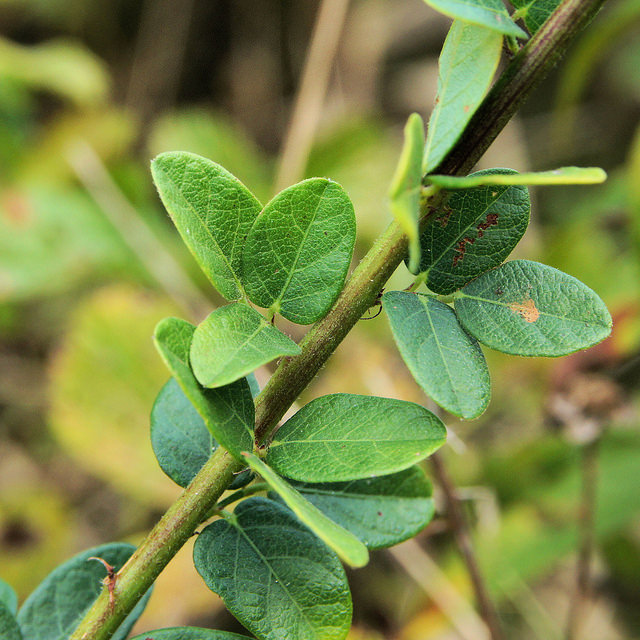
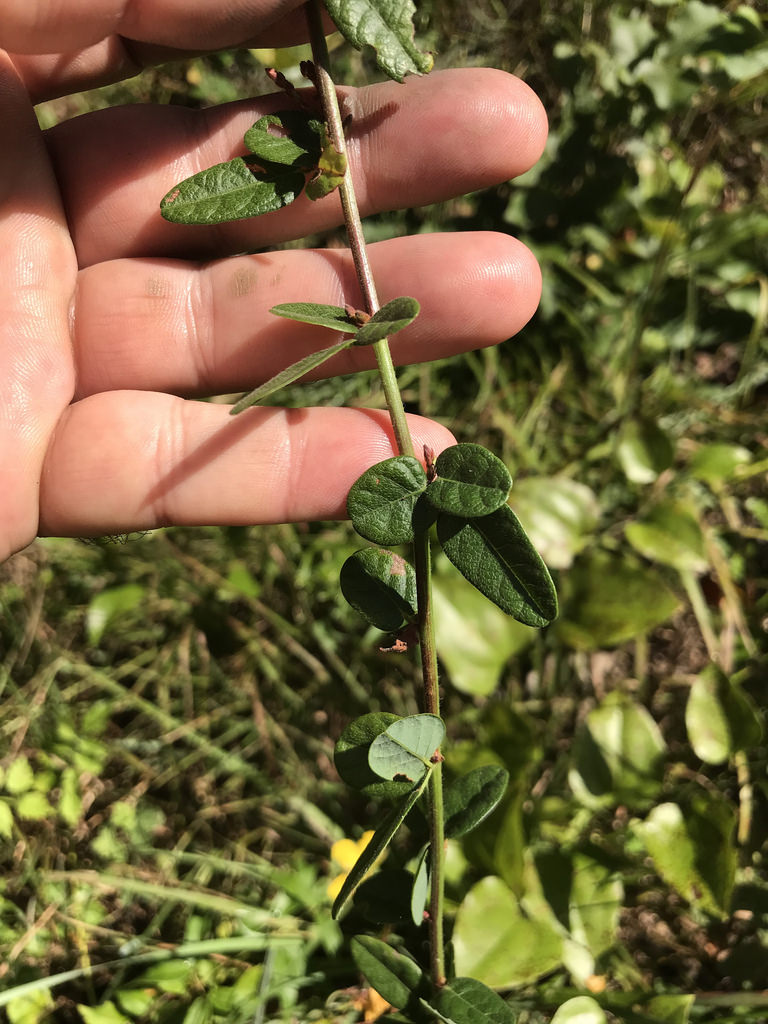
Desmodium ciliare, the hairy small-leaf ticktrefoil, is a perennial forb native to North America. It grows 0.2-1.0 meters tall, has alternate, trifoliolate compound leaves, and pink or purple flowers.[1]
Distribution and habitat
[edit]Desmodium ciliare is distributed from Massachusetts west to Indiana, Missouri, and southeast Kansas, and south to southern Florida and Texas. It grows in fields, woodland borders, and disturbed areas.[2] It tends to be found in mesic areas,[3] and prefers-medium to fine-textured soil that is slightly acidic to soil in pH.[4]
Ecology
[edit]Desmodium ciliare benefits from fire disturbance,[4] and has been shown to increase in frequency in response to fire.[5] Its flower production also increases with burning regiments,[6] although surface fires can decrease germination.[7] Soil disturbance, such as from clearcutting and chopping or military training, reduces its presence in pine communities.[8]
References
[edit]- ^ "Plants of Louisiana". warcapps.usgs.gov. Retrieved 2025-08-29.
- ^ "Desmodium ciliare - FSUS". fsus.ncbg.unc.edu. Retrieved 2025-08-29.
- ^ Carr, Susan C.; Robertson, Kevin M.; Peet, Robert K. (2010). "A Vegetation Classification of Fire-Dependent Pinelands of Florida". Castanea. 75 (2): 153–189. doi:10.2179/09-016.1. ISSN 0008-7475.
- ^ a b Kirk, S. and Belt, S. 2010. Plant fact sheet for Hairy Small-Leaf Ticktrefoil (Desmodium ciliare), USDANatural Resources Conservation Service, Norman A. Bern National Plant Materials Center, Beltsville, 20705.
- ^ Sparks, Jeffrey C.; Masters, Ronald E.; Engle, David M.; Palmer, Michael W.; Bukenhofer, George A. (1998). "Effects of late growing-season and late dormant-season prescribed fire on herbaceous vegetation in restored pine-grassland communities". Journal of Vegetation Science. 9 (1): 133–142. Bibcode:1998JVegS...9..133S. doi:10.2307/3237231. ISSN 1100-9233. JSTOR 3237231.
- ^ Hiers, J. Kevin; Wyatt, Robert; Mitchell, Robert J. (2000). "The effects of fire regime on legume reproduction in longleaf pine savannas: is a season selective?". Oecologia. 125 (4): 521–530. Bibcode:2000Oecol.125..521H. doi:10.1007/s004420000469. ISSN 0029-8549. PMID 28547222.
- ^ Wiggers, M. Scott; Kirkman, L. Katherine; Boyd, Robert S.; Hiers, J. Kevin (2013). "Fine-scale variation in surface fire environment and legume germination in the longleaf pine ecosystem". Forest Ecology and Management. 310: 54–63. Bibcode:2013ForEM.310...54W. doi:10.1016/j.foreco.2013.07.030. ISSN 0378-1127.
- ^ Horn, Scott; Hanula, James L. (2004-07-01). "A Survey of Cavity-Nesting Bees and Wasps in Loblolly Pine Stands of the Savannah River Site, Aiken County, South Carolina". Journal of Entomological Science. 39 (3): 464–469. doi:10.18474/0749-8004-39.3.464. ISSN 0749-8004.
 | This article needs additional or more specific categories. (August 2025) |
 | This Desmodieae-related article is a stub. You can help Wikipedia by adding missing information. |