Map Snapshot


20 Records
Citations
No citations linked for this taxon yet.
Source: Wikipedia
| Candelariella vitellina | |
|---|---|

| |
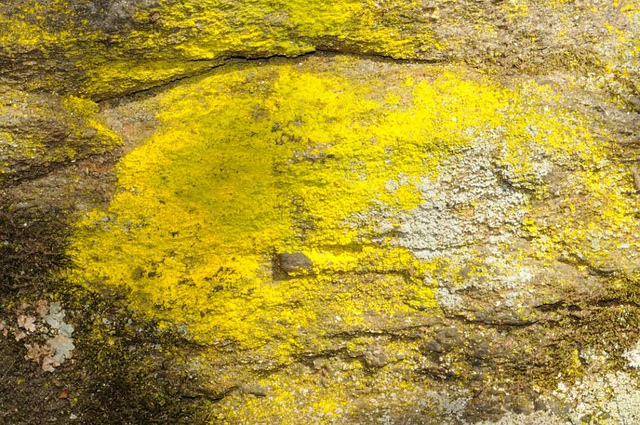
| Candelariella vitellina on granite, magnification 30x | |
Scientific classification 
| |
| Kingdom: | Fungi |
| Division: | Ascomycota |
| Class: | Candelariomycetes |
| Order: | Candelariales |
| Family: | Candelariaceae |
| Genus: | Candelariella |
| Species: | C. vitellina
|
| Binomial name | |
| Candelariella vitellina | |
| Synonyms | |
| |

Candelariella vitellina is a common and widespread green-yellow to orange-yellow crustose areolate lichen that grows on rock, wood, and bark, all over the world.[2] It grows on non-calcareous rock, wood, and bark.[2]
Taxonomy
[edit]The taxon Candelariella vitellina var. mendozae, proposed by Finnish lichenologist Veli Räsänen in 1941,[3] was promoted to distinct species status, Placomaronea mendozae, in 2004.[4]
Description
[edit]Candelariella vitellina often has tiny lobate areoles in the shape of lion claws.[2] The areoles may be flat or convex.[2] Its sexual reproductive structures (apothecia) are a 0.35–1.0 mm-wide disc, darker yellow than the thallus, rimmed with thallus-like tissue (lecanorine), flat but becoming convex with age.[2] The results of lichen spot tests are K+ reddish, KC−, and C−.[2] It produces calycin, pulvinic acid, pulvinic dilactone and vulpinic acid as secondary metabolites.[2]
Candelariella vitellina looks like a miniature version of C. rosulans.[2] It can be distinguished by C. vitanela having a visible exciple (the rim around the apothecia disc), which C. rosulans does not have.[2] It is usually much larger and thicker than the similar C. lutella.[2]
Habitat and distribution
[edit]In California, it prefers growing on granite, but can also be found on wood (rarely on bark) and other kinds of rock.[5]: 251
Species interactions
[edit]It is a known host to the lichenicolous fungus species Carbonea vitellinaria.[6][7]
References
[edit]- ^ NatureServe. "Candelariella vitellina". NatureServe Explorer. Arlington, Virginia. Retrieved 31 July 2025.
- ^ a b c d e f g h i j Lichen Flora of the Greater Sonoran Desert Region. Vol 2, Nash, T.H., Ryan, B.D., Gries, C., Bugartz, F., (eds.) 2001, [1]
- ^ Räsänen, V. (1941). "La flora liquenologica de Mendoza (Argentina)" (PDF). Anales de la Sociedad Científica Argentina, Buenos Aires E III. 131: 97–110 [100].
- ^ Westberg, M. (2004). "Placomaronea". In Nash III, T.H.; Ryan, B.D.; Diederich, P.; Gries, C.; Bungartz, F. (eds.). Lichen Flora of the Greater Sonoran Desert Region. Vol. 2. Tempe, Arizona: Lichens Unlimited, Arizona State University. p. 419. ISBN 978-0-9716759-1-9.
- ^ Field Guide to California Lichens, Stephen Sharnoff, Yale University Press, 2014, ISBN 978-0-300-19500-2
- ^ Brackel, Wolfgang von (2011). "Lichenopeltella rangiferinae sp. nov. and some other lichenicolous fungi from Iceland" (PDF). Acta Botanica Islandica. 15: 51–60.
- ^ Alstrup, V.; Olech, M.; Wietrzyk-Pelka, P.; Wegrzyn, M. H. (2018). "The lichenicolous fungi of the South Shetland Islands, Antarctica: species diversity and identification guide". Acta Societatis Botanicorum Poloniae. 87 (4): 3607. doi:10.5586/asbp.3607.