Map Snapshot


9 Records
Status
Description
Relationships
Citations
No citations linked for this taxon yet.
Source: Wikipedia
| Panaeolus papilionaceus | |
|---|---|

| |
Scientific classification 
| |
| Kingdom: | Fungi |
| Division: | Basidiomycota |
| Class: | Agaricomycetes |
| Order: | Agaricales |
| Family: | Bolbitiaceae |
| Genus: | Panaeolus |
| Species: | P. papilionaceus
|
| Binomial name | |
| Panaeolus papilionaceus | |
| Synonyms | |
|
Agaricus calosus | |
| Panaeolus papilionaceus | |
|---|---|
| Mycological characteristics | |
 | Gills on hymenium |
 | Cap is convex |
 | Hymenium is adnexed |
 | Stipe is bare |
 | Spore print is black |
 | Ecology is saprotrophic |
 | Edibility is inedible |
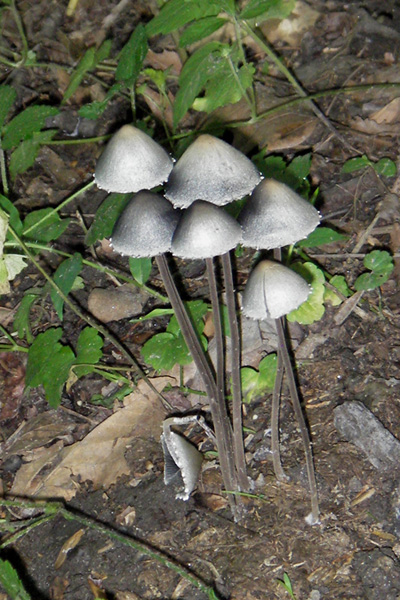
Panaeolus papilionaceus,[a] commonly known as the bell-capped mottlegill[2] or Petticoat mottlegill, is a very common and widely distributed small brown mushroom that feeds on dung.
This mushroom is the type species for the genus Panaeolus.
Description
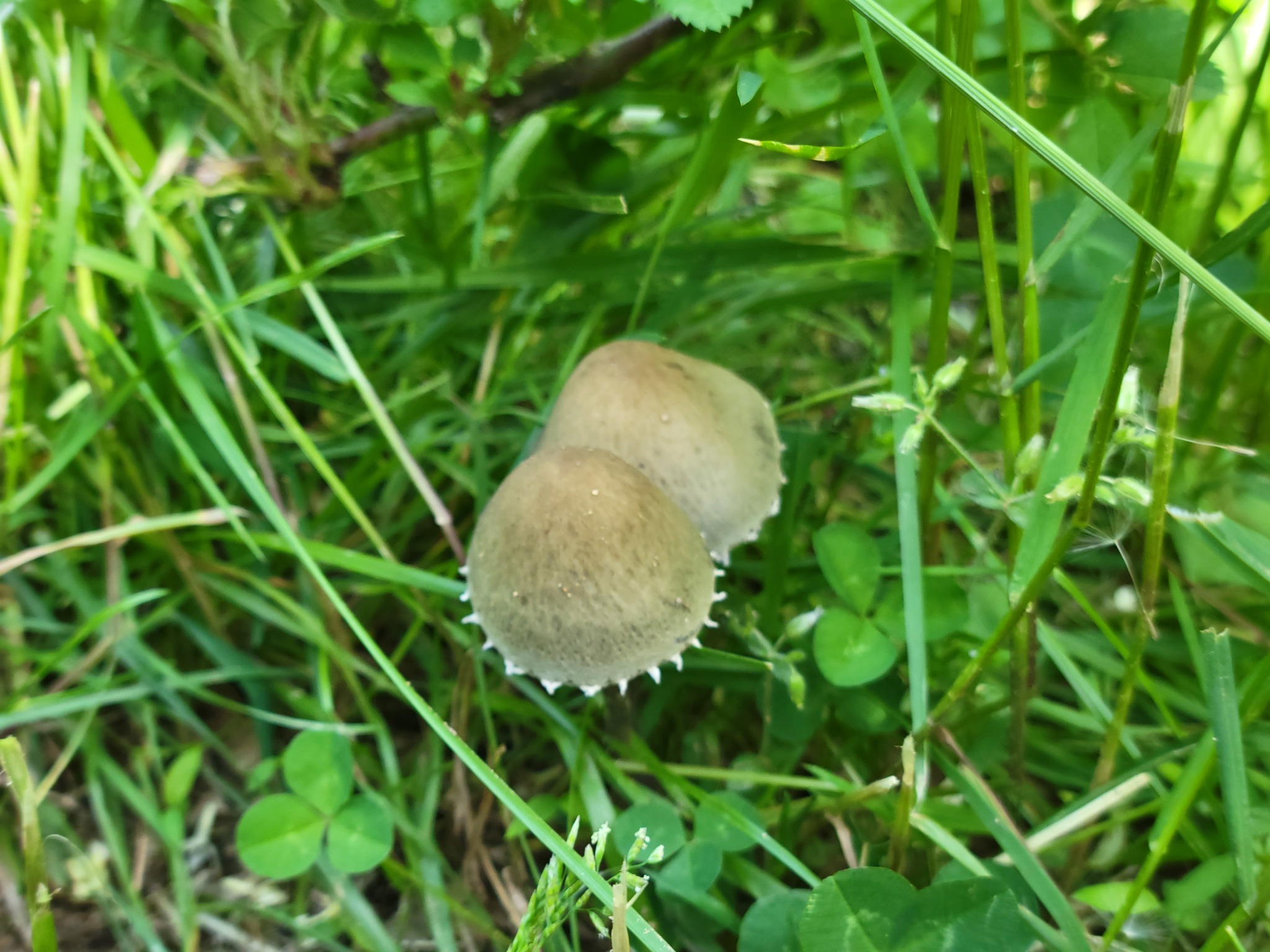
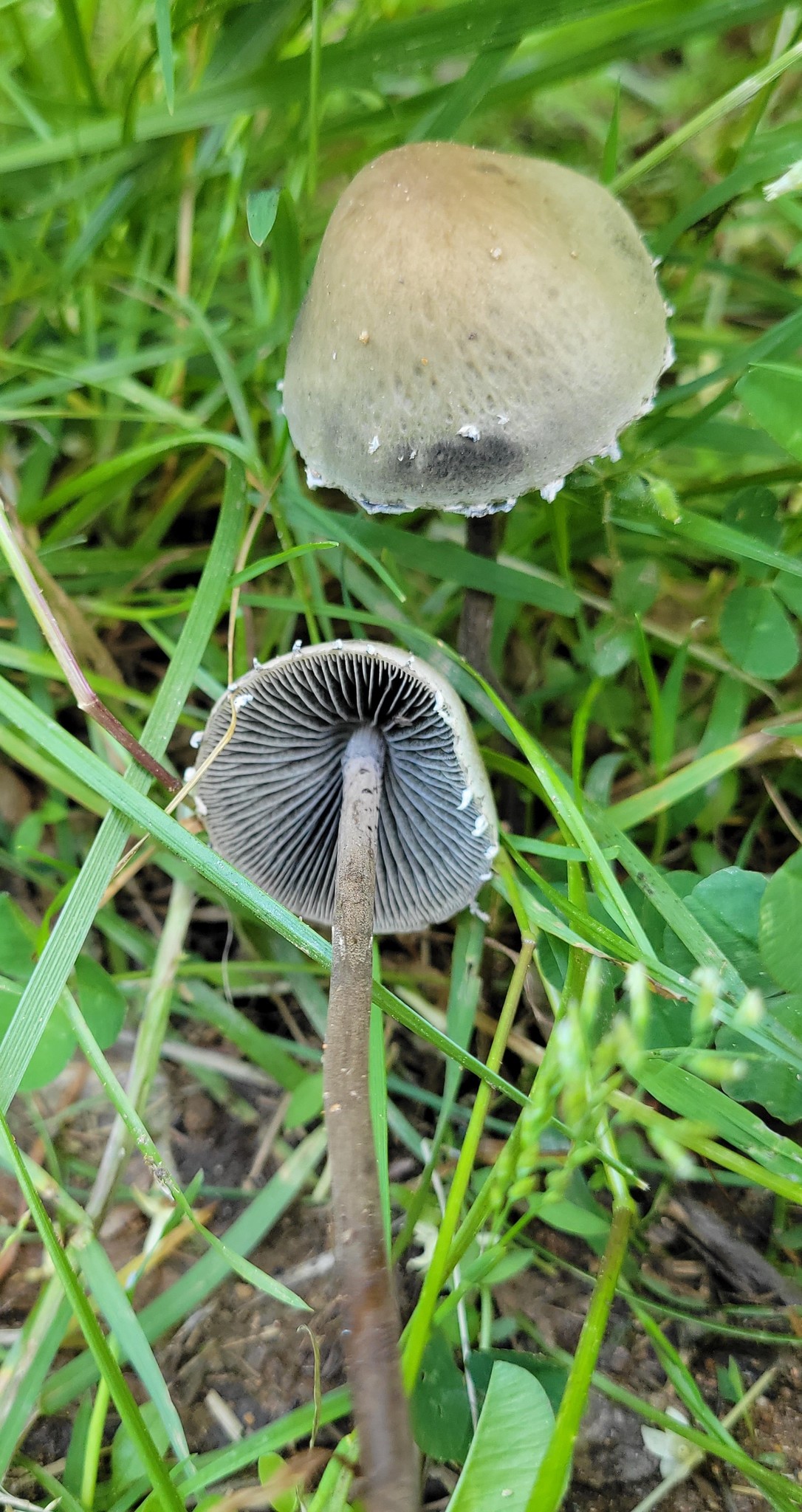
[edit]The cap is 1–5 centimetres (1⁄2–2 in) across, obtusely conic then becoming campanulate, and grayish brown.[1] It is not hygrophanous and the margin is adorned with white toothlike partial veil fragments when young or towards the edge.[1] The flesh is thin.[3]
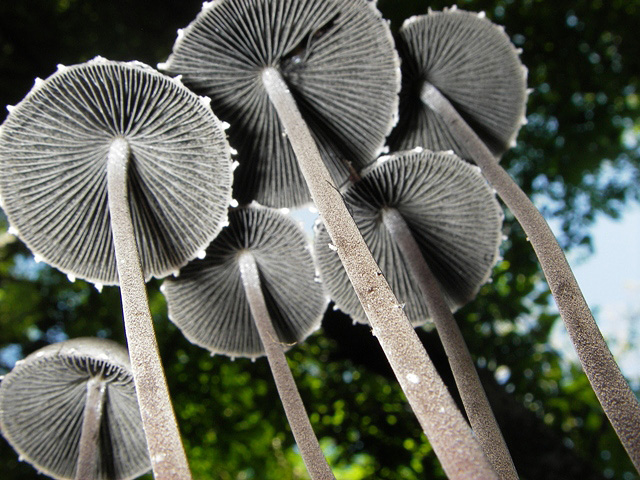
The gills are adnate to adnexed, close to crowded,[3] one or two tiers of intermediate gills, pale gray, acquiring a mottled, blackish appearance in age, with whitish edges. The spore print is black.[3]
The stipe is 6–12 cm by 2–4 mm, gray-brown to reddish brown, darker where handled, paler toward the apex, brittle,[1] fibrous, and pruinose.
The odor is mild and the taste unappetizing.
Microscopic features
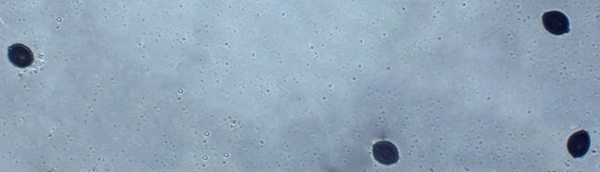
[edit]The spores are 12–18 x 7–10 μm, elliptical, smooth, with an apical pore.
Basidia 4-sterigmate; abruptly clavate. Cheilocystidia abundant; subcylindric, often subcapitate or capitate.
Similar species
[edit]Panaeolus retirugis is similar but more robust, with a larger cap and thicker stem.[4] Panaeolus pantropicalis has a more tropical distribution than Panaeolus papilionaceus and Panaeolus retirugis.[5]
Habitat and formation
[edit]Occurring singly, gregariously, or caespitosely on cow/horse dung, moose droppings, and in pastures. Widely distributed in North America throughout the year, but only in warmer climates in winter. It can be found in countries including[6] Canada (Alberta,[7] British Columbia), the United States (Alabama, Alaska, California,[7] Colorado, Florida, Georgia,[7] Indiana,[7] Louisiana,[7] Maine, Massachusetts, Missouri, Montana,[7] New Mexico, New York, Oklahoma, Texas,[7] Washington),[7] the Caribbean (Bahamas, Cuba, San Vincent Island), Chile, Colombia, Uruguay, France, The Netherlands, Greece, Mexico,[7] Norway, Slovenia,[7] South Africa, Uganda, China, Iran, Lithuania, Kuwait, and the Philippines.
Edibility
[edit]Panaeolus papilionaceus is inedible[8] and is not substantial. While similar-looking species, such as Psilocybe mexicana, contain psilocybin, P. papilionaceus does not.[9]
Gallery
[edit]-
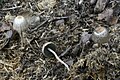
 P. papilionaceus var. papilionaceus
 -

-

-
-


_Qu%C3%A9l_183735.jpg)


See also
[edit]
References
[edit]Footnotes
Citations
- ^ a b c d Trudell, Steve; Ammirati, Joe (2009). Mushrooms of the Pacific Northwest. Timber Press Field Guides. Portland, OR: Timber Press. p. 201. ISBN 978-0-88192-935-5.
- ^ Siegel, Noah; Schwarz, Christian (September 1, 2024). Mushrooms of Cascadia: A Comprehensive Guide to Fungi of the Pacific Northwest. Humboldt County, CA: Backcountry Press. p. 104. ISBN 9781941624197.
- ^ a b c Arora, David (1986) [1979]. Mushrooms Demystified: A Comprehensive Guide to the Fleshy Fungi (2nd ed.). Berkeley, CA: Ten Speed Press. pp. 356–57. ISBN 978-0-89815-170-1.
- ^ Voto, Pietro; Angelini, Claudio; Botánico, Jardín; Rafael, Nacional; Republic, Dominican (2024-07-29). "New data Panaeolus papilionaceus complex P. punjabensis". ResearchGate. pp. 40–57. Retrieved 2026-01-22.
- ^ Voto, Pietro; Angelini, Claudio (2024-04-09). "Studies in the Panaeolus papilionaceus complex (Agaricales, Galeropsidaceae): two new species discovered in the Dominican Republic and Australia. Mycological Observations". ResearchGate. p. 1–32. Retrieved 2026-01-22.
- ^ Worldwide Distribution of Neurotropic Fungi, Guzman (www.museocivico.rovereto.tn.it)
- ^ a b c d e f g h i j Panaeolus papilionaceus The Mushroom Observer (mushroomobserver.org)]
- ^ Phillips, Roger (2010). Mushrooms and Other Fungi of North America. Buffalo, NY: Firefly Books. p. 236. ISBN 978-1-55407-651-2.
- ^ Allen, John W. (2013). Ethnomycological Journals: Sacred Mushroom Studies Volume IX. Santa Cruz, California and Seattle, Washington, respectively: MAPS and Exotic Furays. pp. 130–175. ISBN 978-158-214-396-5.
External links
[edit]- Mushroom Expert - Panaeolus papilionaceus
- Mykoweb - Panaeolus papilionaceus
- Observations on Mushroom Observer
- [1]The most recent taxonomic treatment of this group]