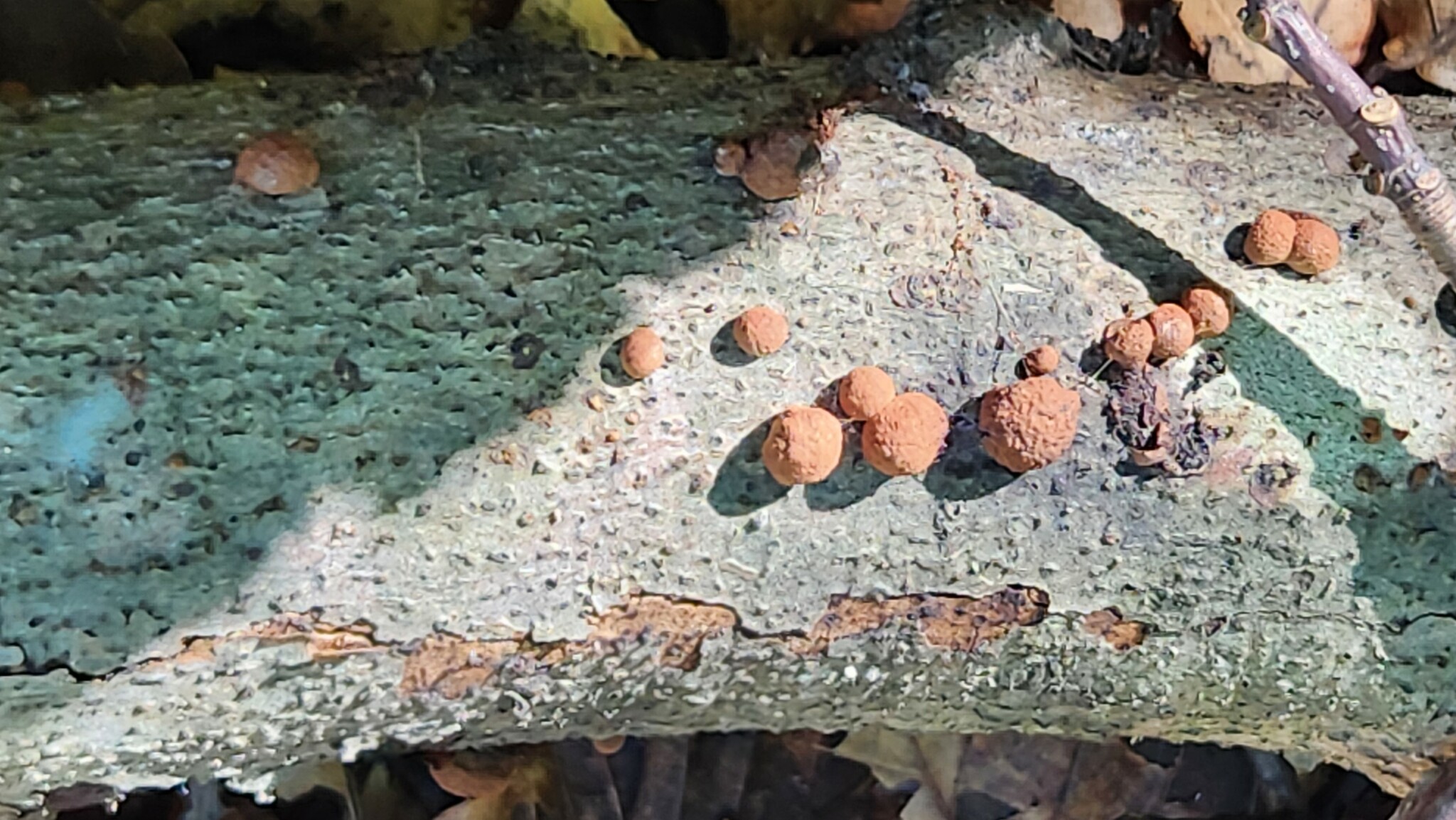
Map Snapshot


5 Records
Citations
No citations linked for this taxon yet.
Source: Wikipedia
| Hypoxylon | |
|---|---|

| |
Scientific classification 
| |
| Kingdom: | Fungi |
| Division: | Ascomycota |
| Class: | Sordariomycetes |
| Order: | Xylariales |
| Family: | Hypoxylaceae |
| Genus: | Hypoxylon Bull. |
| Type species | |
| Hypoxylon coccineum Bull.
| |
| Species | |
|
Species include: | |
Hypoxylon is a genus of ascomycetes commonly found on dead wood, and usually one of the earliest species to colonise dead wood. A common European species is Hypoxylon fragiforme which is particularly common on dead trunks of beech.
Based on morphological studies and gene sequence analyses, 27 species formerly assigned to Hypoxylon sect. Annulata were reassigned to a new genus called Annulohypoxylon in 2005.[2]
Research in Iran has shown the potential of some species of Hypoxylon in producing chemicals that are antagonistic against the disease ash dieback.[3]
Use in the cultivation of Tremella fuciformis
[edit]Some species in the genus Hypoxylon may be used in the cultivation of Tremella fuciformis, one of the foremost medicinal and culinary fungi of China and Taiwan.[4]
Tremella fuciformis is a parasitic yeast that does not form an edible fruitbody without parasitizing another fungus.[4] Its preferred host, formerly known as Hypoxylon archeri,[4] was moved to the closely related genus Annulohypoxylon and is now known as Annulohypoxylon archeri.[2] Cultivators usually pair cultures of Tremella fuciformis with this species, but mushroom cultivation books written before the new genus was created suggest other Hypoxylon species may be used.[4]
Gallery
[edit]-
 Hypoxylon sp.
 -
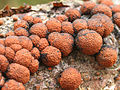
-
 Hypoxylon fragiforme
 -
 Nectria episphaeria (red beads) growing on Hypoxylon fragiforme
 -
 Nectria episphaeria growing on Hypoxylon fragiforme


See also
[edit]
References
[edit]- ^ Ma, Haixia; Song, Zikun; Pan, Xiaoyan; Li, Yu; Yang, Zhanen; Qu, Zhi (January 2022). "Multi-Gene Phylogeny and Taxonomy of Hypoxylon (Hypoxylaceae, Ascomycota) from China". Diversity. 14 (1): 37. doi:10.3390/d14010037.
- ^ a b Hsieh, Huei-Mei; Ju, Yu-Ming; Rogers, Jack D. (July–August 2005). Natvig, Don (ed.). "Molecular phylogeny of Hypoxylon and closely related genera". Mycologia. 97 (4): 844–865. doi:10.3852/mycologia.97.4.844. PMID 16457354.
- ^ Pourmoghaddam, Mohammad Javad; Lambert, Christopher; Surup, Frank; Khodaparast, Seyed Akbar; Krisai-Greilhuber, Irmgard; Voglmayr, Hermann; Stadler, Marc (2020). "Discovery of a new species of the Hypoxylon rubiginosum complex from Iran and antagonistic activities of Hypoxylon spp. against the Ash Dieback pathogen, Hymenoscyphus fraxineus, in dual culture". MycoKeys. 66: 105–133. doi:10.3897/mycokeys.66.50946. PMC 7195382. PMID 32377154.
- ^ a b c d Stamets, Paul (2000). "Chapter 21: Growth Parameters for Gourmet and Medicinal Mushroom Species". Growing gourmet and medicinal mushrooms = [Shokuyo oyobi yakuyo kinoko no sabai] (3rd ed.). Berkeley, California, USA: Ten Speed Press. pp. 402–405. ISBN 978-1-58008-175-7.
External links
[edit]
- Index Fungorum
- Page with extensive information on the Hypoxylon genus
- Pyrenomycetes from southwestern France
| Authority control databases: National |
|---|
