Map Snapshot


68 Records
Citations
No citations linked for this taxon yet.
Source: Wikipedia
| Paspalum laeve | |
|---|---|

| |
| Paspalum laeve | |
Scientific classification 
| |
| Kingdom: | Plantae |
| Clade: | Tracheophytes |
| Clade: | Angiosperms |
| Clade: | Monocots |
| Clade: | Commelinids |
| Order: | Poales |
| Family: | Poaceae |
| Subfamily: | Panicoideae |
| Genus: | Paspalum |
| Species: | P. laeve
|
| Binomial name | |
| Paspalum laeve Michx.
| |
Paspalum laeve common name field paspalum, is a plant found in North America. [1] Its distribution ranges from the southeastern United States northward to New York and westward to Texas and Kansas.[2]
It is listed as threatened in Connecticut.[3] Paspalum laeve var. circulare, common names round field beadgrass and hairy field beadgrass, is endangered in New York (state).[1]
Description
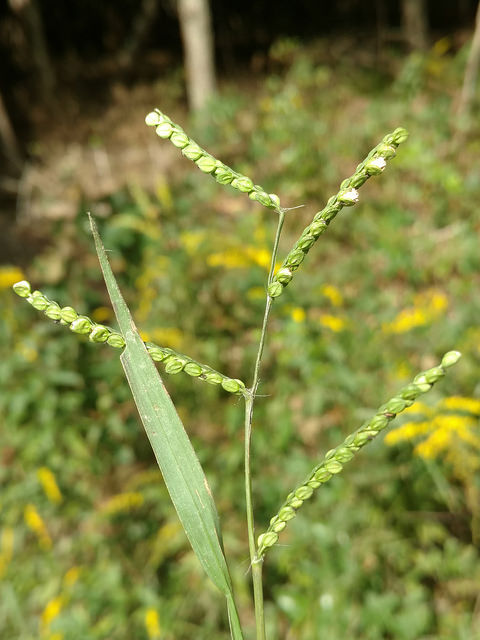
[edit]P. laeve's blades are 20 centimeters (approximately 8 inches) in length, with a width ranging between 1 and 10 millimeters (0.03 to 0.3 inches). It spikelets grow in two rows, and are 2.5 to 3 millimeters across.[2]
Habitat
[edit]This species is found on forest edges and can grow in areas that have been disturbed.[4] Specimens of P. laeve have been collected from habitats such as coastal hammocks, wiregrass palmetto flatwoods, pond edges, low field, and old pasture.[5] P. laeve has intermediate levels of drought and shade tolerance.[2]
References
[edit]- ^ a b NRCS. "Paspalum laeve". PLANTS Database. United States Department of Agriculture (USDA). Retrieved 3 April 2021.
- ^ a b c "USDA Plants Database". plants.usda.gov. Retrieved 2025-08-04.
- ^ "Connecticut's Endangered, Threatened and Special Concern Species 2015". State of Connecticut Department of Energy and Environmental Protection Bureau of Natural Resources. Retrieved 17 January 2018. (Note: This list is newer than the one used by plants.usda.gov and is more up-to-date.)
- ^ Weakley, A. S. (2015). Flora of the Southern and Mid-Atlantic States. Chapel Hill, NC, University of North Carolina Herbarium.
- ^ "Robert K. Godfrey Herbarium".
 | This Panicoideae article is a stub. You can help Wikipedia by adding missing information. |